Whatever one does or doesn't do is collective action towards reducing emissions or not reducing emissions. There are people pulling in both directions and it is your action, not your intent or feelings that determines which side you are pulling on. We can't think or worry greenhouse gases away. We actually have to stop polluting.

More than half of Canadians are among the wealthiest 10% on Earth. On average, Canadians have bigger carbon footprints than those in 95–97% of other countries, including most other cold climate countries. Those with the means should be among the first to reduce our emissions.

But moral arguments aside, there are many economic and other benefits to reducing emissions. The new technologies are better, have co-benefits for health and well-being, are often economically competitive upfront or have payback periods leading to increased affordability.

And of course their collective adoption means we avoid passing on devastating social and economic costs too our children — the ones alive today — if you believe over 99% of the scientific research. It was never going to be ‘all or none.’ It was always going to be a wave of action and the wave, albeit a choppy one, is underway.
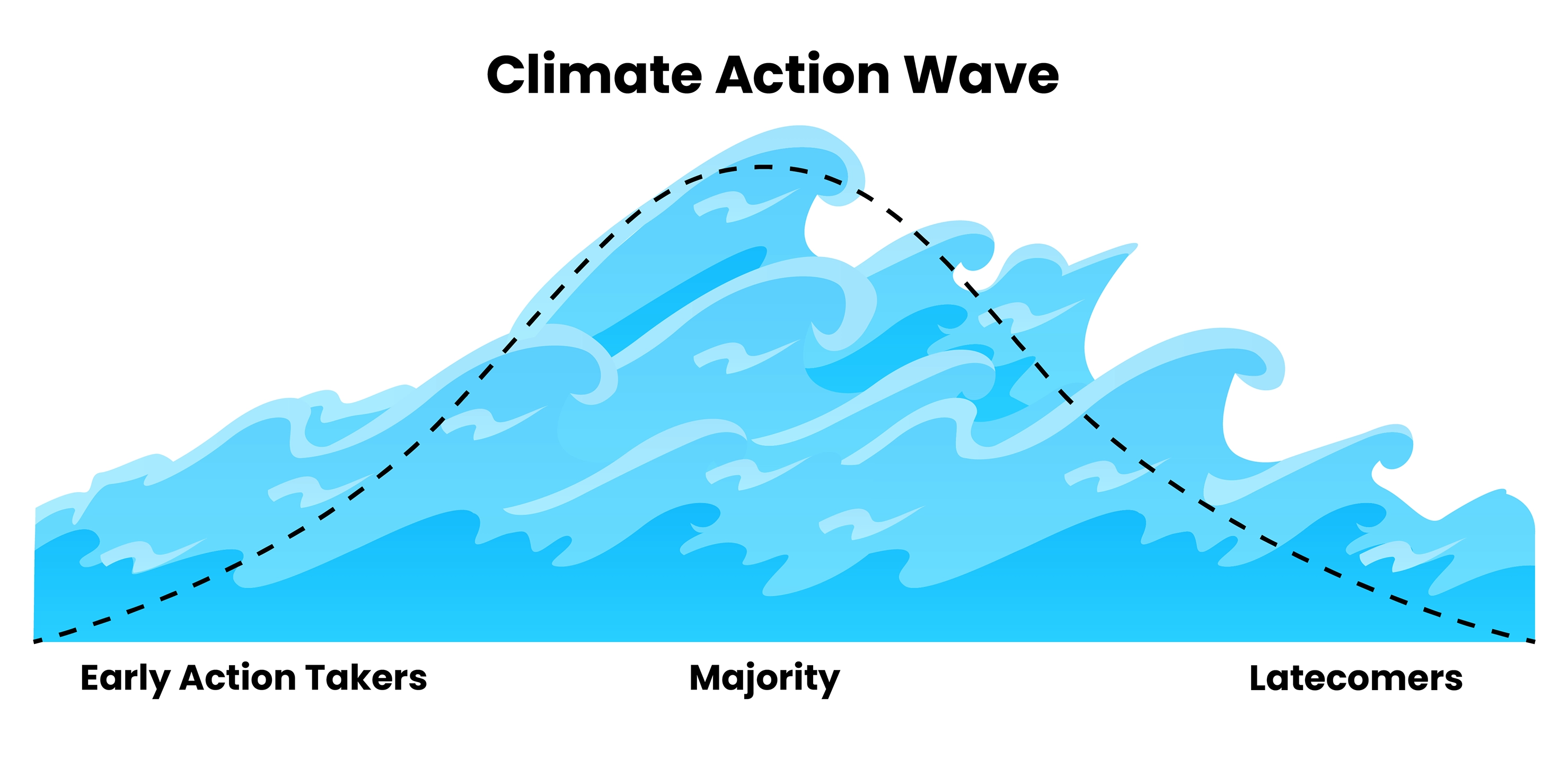

Join the carbon wave.

Just a drop in the ocean?

• Everyone's choices matter. As an individual, you are making choices with billions of other individuals.

• You aren't alone. You will never be the only one making changes for a better world and there are hundreds of millions of others who care and are willing to do something about the climate crisis however small.

• It's only a matter of time. For most of us, the question isn't whether we will be transitioning to a cleaner less polluting economy, but rather when and how quickly.

As a Canadian…

• Canadians have one of the largest per capital greenhouse gas emissions in the world. Your individual actions have a disproportionately large global impact.

• Even though we have clean and cheap electricity compared to other developed nations, we live carbon intensive lives and have a carbon intensive economy.

Your impact is far reaching

• Your impact will go beyond yourself. When people see others changing they are more likely to change too.

• People are more likely to act, more likely to talk about changes they are making, and more likely to elect and direct leaders who support and accelerate the needed change.

You have more power to act than most

• Living in a developed country, you have more power to act than many in the global South.

• Living in a period of time where the door is closing on avoiding tipping points that will cause runaway climate change, you have more power to act than future generations that need you to act now.

• Other species need us to do it too.

Change requires all of us

• Systemic change requires individual action. Systemic change cannot happen without public support and businesses can't be successful in their efforts without the support of consumers.

• Governments can set the directions and conditions for change using policies, financial subsidies, investment and other incentives and financial disincentives like taxes and fines.

• And governments need businesses and civil society (all of us) to support and help implement the changes.

Some Stats

Insert stats here.

Common Myths and Barriers

Canada’s emissions are negligible. If you want to address climate change, look at the big emitters like China and India.

It’s true that Canada emits less than 2% of global greenhouse emissions but this is not a valid argument against implementing robust climate policies.

Canada’s climate action matters on a global scale because…

• Although our total emissions may seem low, our per person emissions are among the worst in the world. While countries like China have more total emissions, Canada's per person emissions are twice as high as China's.

• If every country with less than two per cent of global emissions did nothing, the biggest chunk of emissions would remain unaddressed. Only six countries have emissions that account for more than 2% of the global total. Every country that emits less than 2% makes up 36% of emissions collectively.

• Wealthy countries such as Canada that have emitted the most historically have the best means to reduce emissions and therefore the moral responsibility to do so. Climate change is driven by the cumulative, not annual, amount of greenhouse gas emissions. So, the historical context of which countries have emitted the most over time matters. Canada is ranked 10th in the world for total cumulative emissions.

• The fossil fuels we export don’t count toward our national emissions. Canada exports most of its crude oil and just under half of its natural gas. The burning of these fossil fuels is 1.3x more than the total greenhouse gases emitted at home. When you take this into account, it becomes clear that Canada's energy sector, energy policies, and climate ambition are significant on the global stage.

• Canada is sitting on the 3rd largest oil and gas reserves in the world, representing 10% of all global deposits. Leaving our massive, environmentally destructive, oil and gas deposits in the ground would go a long way to preventing further climate chaos.

My choices don't matter

Consumer demand shapes what companies make, promote, and prioritize

Every time you buy the more sustainable option from companies taking action, opt for quality over quantity, avoid excessive plastic packaging, refuse less durable and/or more disposable items, buy things that can be repaired, or choose experiences over owning more stuff, you are putting pressure where businesses pay the most attention.

Policy drives systemic change but consumer behaviour fuels it.

People are not taking climate action

People underestimate how much other people care about and are willing to act on climate change

Globally and in Canada, people underestimate how much other people care about and are willing to act on climate change. Key transitions requiring individual action, like shifting to clean energy transportation and efficient, clean energy homes are happening in Canada and elsewhere. Behavioural shifts in consumption towards sustainable products are also occurring, led by Gen Z consumers.

People won't change their behaviour so what's the point?

People are changing their shopping behaviours based on sustainability including climate change

More myths and barriers here.