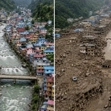
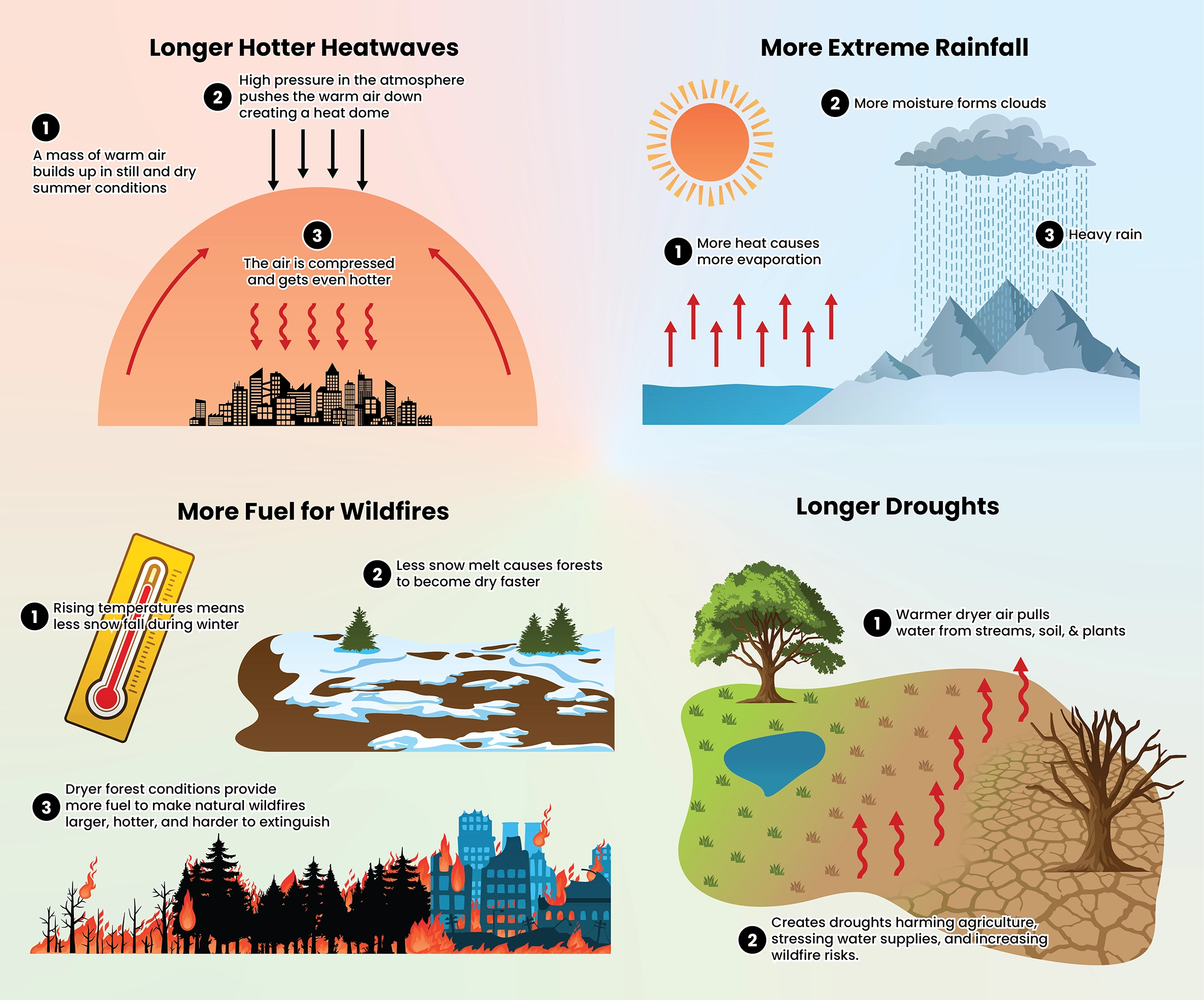
Global warming increases the likelihood, severity, and frequency of climate disasters and severe weather events. This includes:
• Hurricanes
• Droughts
• Heatwaves
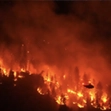
• Wildfires
• Severe winter storms
• Torrential rainfalls
• Typhoons
• Permafrost thawing
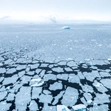
• Loss of arctic and antarctic sea ice
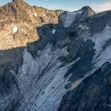
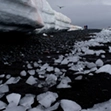
• Melting of glaciers and ice sheets
• Sea level rise
• Flooding
• Coastal erosion
• Tipping points of no return
• Biodiversity loss due to shifting weather patterns, ocean heating, and severe climate events like floods and wildfires.
• Species shifts that disrupt ecosystems as they move out of climate impacted areas or expand their ranges.
• Shifts of disease vectors, and plant and insect pests to new areas.
• Reduced ability for ecosystems to store carbon as forests shrink and oceans warm — can flip to emitting carbon, making warming worse
Tipping points are predicted to occur where we will no longer be able to stop increasing the temperature of the earth. We will have runaway climate change even after we stop burning fossil fuels, because of feedback loops. We don't know exactly when these could happen but we can watch for the warning signs.
Ice Sheets of Greenland and Antarctica — as oceans warm, they are causing ice sheets to melt. Once a critical mass of ice melt occurs, a runaway feedback loop of irreversible melting over the long term will happen, causing unavoidable sea level rise.
Ocean ecosystems — global warming heats up the oceans too and causes the ocean to be more acidic. This kills beautiful ecosystems like coral reefs, and mangrove and seagrass ecosystems. We cannot easily resurrect a collapsed ecosystem.
Patterns of ocean currents — warming the ocean as it absorbs some of our carbon pollution also disrupts the ocean currents — the hot and cold streams that interact to regulate ocean flows and land weather patterns around the world. Disrupting, slowing, or stopping these currents would cause massive irreversible changes to our land temperatures and weather patterns. Large areas may become significantly and irreversibly hotter or colder and wetter or drier than they are now.
Forests — the hot dry conditions of global warming makes wildfires more widespread and harder to control. This causes all of the carbon they store for us to be emitted into the atmosphere. Instead of tying up carbon for us as they grow, they release it into the atmosphere when they burn (just like fossil fuel carbon pollution), which makes the earth hotter, which makes wildfires worse, which causes more forest loss. Another potential runaway feedback loop.
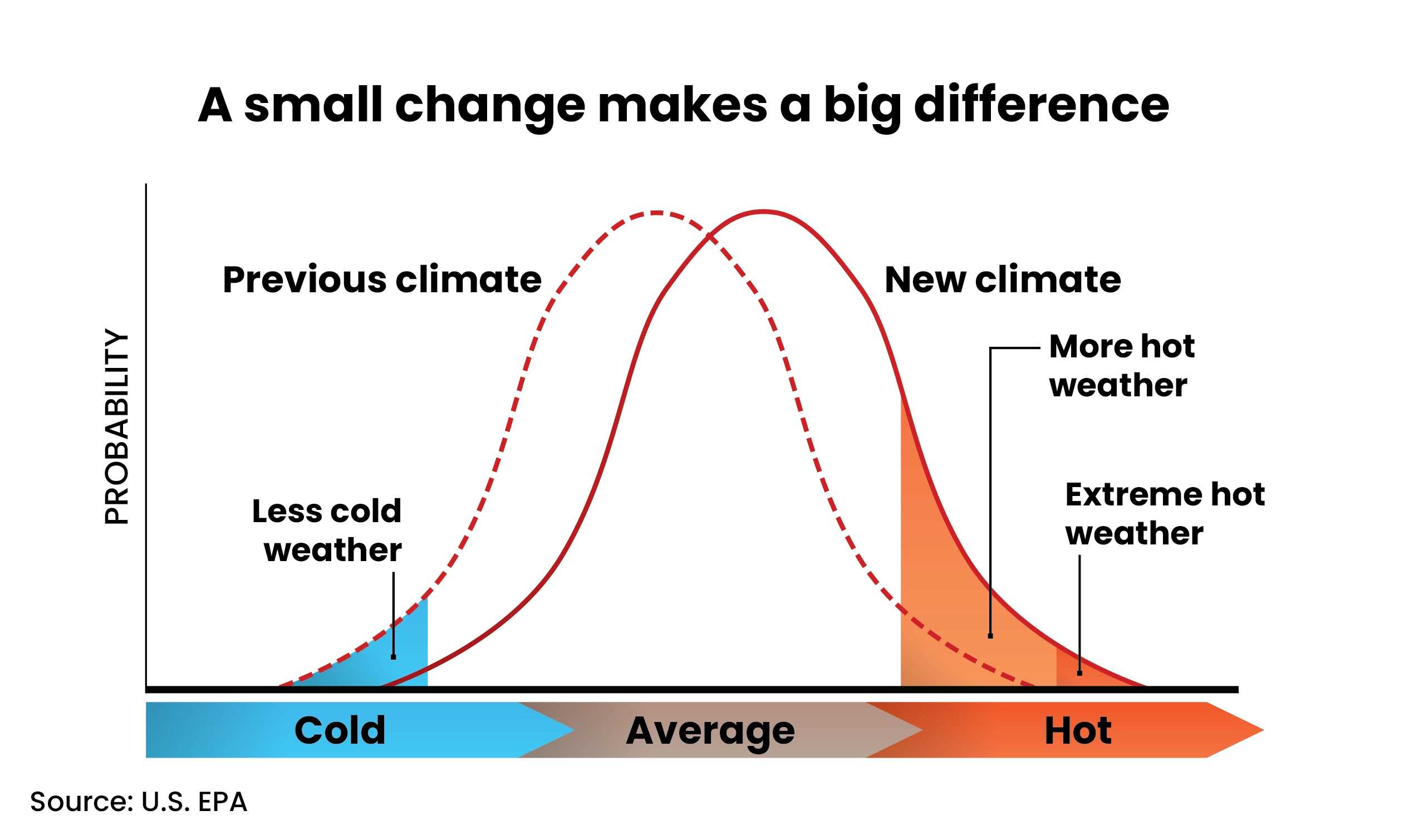
We have built our world in a relatively stable climate. Weather patterns are variable and temperatures fluctuate but within known ranges.
Our buildings and infrastructure, travel and mobility, food systems, health, access to life sustaining water and resources, economies, cities and quality of life depend on staying within certain guardrails that we are now breaking.
The impacts of climate change are vast and diverse. A few examples…
• Direct loss of life during heat waves, floods and landslides, wildfires
• Direct loss of livelihoods, homes and communities, and forced evacuations and permanent displacement
• Lower agricultural productivity and/or output due to water scarcity, severe weather, climate change induced pest infestations
• Increased food costs for climate impacted crops.
• Increased human/animal disease prevalence and spread to new areas (e.g. Lyme disease, spread of water borne diseases during floods)
• Worsened health outcomes, particularly for those with preexisting health conditions or more vulnerable populations due to heat/cold extremes, lower air quality, exposure to flood events, overtaxed health care systems
• Lost productivity/income (indoors and out) due to heat, poor air quality, extreme cold, lack of indoor temperature control
• Damage to infrastructure due to floods and wildfires, permafrost melting in the North, railways and roads buckling due to heat, storm damage, power outages
• Disrupted supply chains, business activity and travel as water levels in shipping channels decrease, infrastructure is impacted, factories become too hot to operate, extreme weather, wildfires and flooding disrupt business and travel.
• Reduction of hydropower capacity and nuclear capacity as warming reduces water levels and heats nuclear reactors beyond safety limits
• Direct costs for individuals and governments/societies from flooding and wildfires and increased insurance costs
• Straining system resources in firefighting and emergency services which also reduces capacity for non-climate emergency services and non-urgent care
• Decreased quality of life and mental health
It's not just about the environment. It's about health and wellbeing, the economy, cost of living, livelihoods, quality of life and increasingly life and death itself.
It's going to cost money to transition to clean energy, build more sustainable and resilient societies and economies, and restore ecosystems and biodiversity.
The outcomes of those costs are green economy jobs, economic stability, cleaner air, lower costs of living, resilient and sustainable communities and a healthy environment.
The most cost effective time to change is right now. The more we delay, the costlier the transition will be.
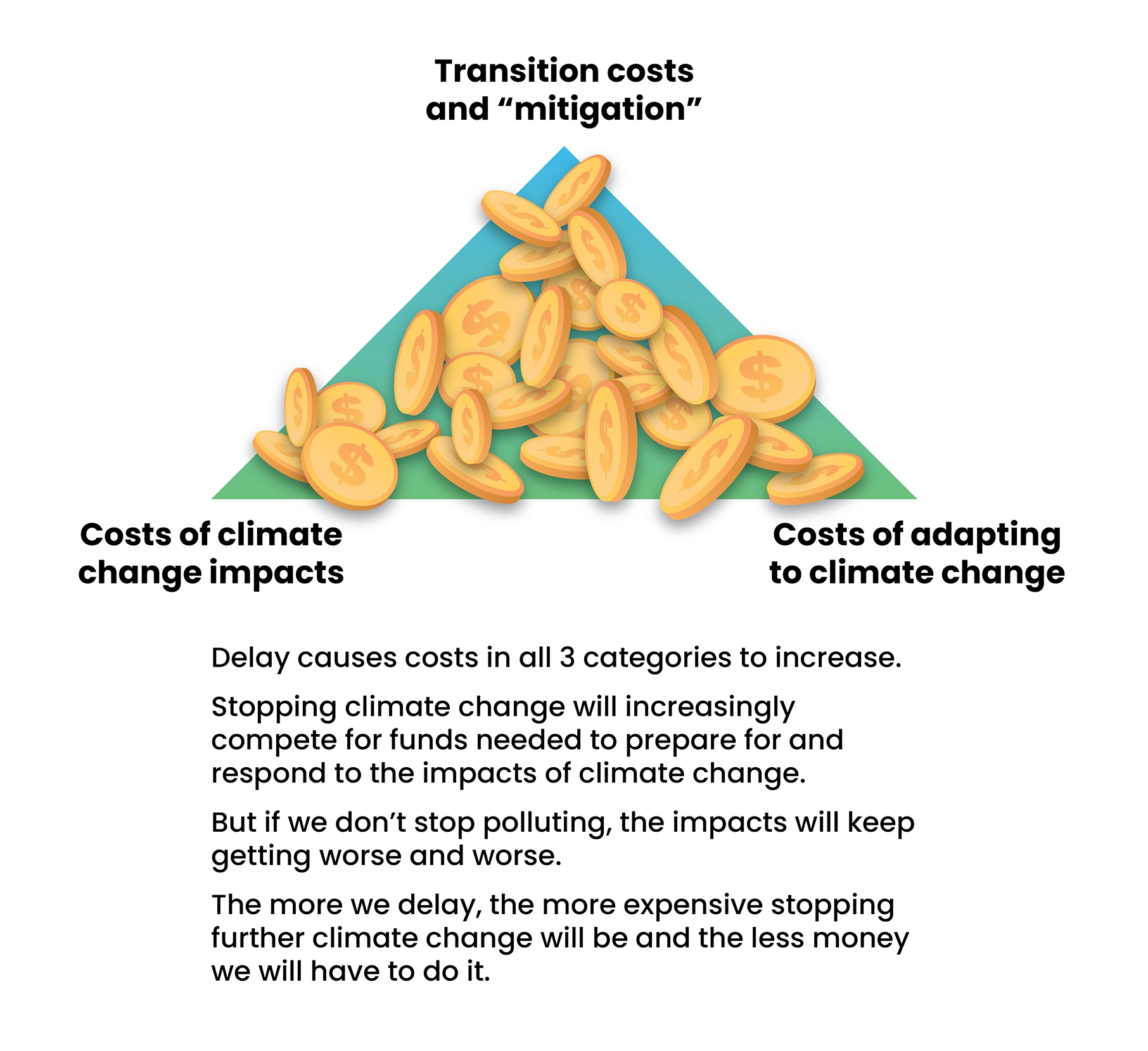
The longer we delay, the more we will need to rely on the most expensive/wild card/moonshot solutions (such as carbon capture and storage, geoengineering) and more costly, aggressive, timescales will be required for deployment.
The worse climate change gets, the more risks there are to current clean solutions. Droughts impact the effectiveness of hydropower. Irreversible changes to weather patterns can impact solar and wind investments.
Reforestation efforts can be thwarted by wildfires or climate-related damage from invasive species. Wildfires reduce efficacy of solar and nuclear reactors have to be turned off in extreme heat.
The annual costs of climate change damage are in the 100s of billions globally and at least 25 billion in Canada, or the equivalent of about 5–6% of our GDP. This does not include many indirect costs as health care costs.
Climate change costs that increase the longer we delay:
• Wildfire fighting and damage, and flood damage costs — which means increased taxes
• Increased home insurance premium costs
• Increased agricultural insurance costs — which means increased taxes
• Increased infrastructure damage costs — which means increased taxes
• Increased grocery bills
• Lost productivity costs, slowed economic activity
• Increased health and health system costs
• Increased costs of protecting vulnerable populations
The longer we delay, the more adaptation will be needed as more regions and populations are impacted and climate risks become more severe.
We will need new types of infrastructure to handle high heat as roads and railways buckle in the heat, transport ships can't move through low waterways. Cooling systems will need to pervasively adopted. Wildfire management will be more intensive, pervasive, and costly. Storm water management and flood protection will need to be more pervasive and aggressive. Cooling, warming and storm/flood centres will be needed in each city. Water sources will need great protection.
The worse we let the situation get, the more risks there will also be to current adaptation solutions. Seawalls are only effective up to certain levels of sea rise, for example. And in some cases, entire cities will need to be moved. Some island nations have already begun mass emigration.
On the plus side, investing in adaption reduces the impacts of disasters. Preparing for a warmer world is money well invested to avoid costs of damages.
Rapid shifts in ecosystems that in which species of plants and animals don't have time to adapt leading to adverse impacts for a vast number of plant and animal species.
Biodiversity loss is tragic in and of itself but population changes and extinctions also do the following:
• Bring risks to ecosystems, food systems, and water systems that humans depend on.
• Reduce ecosystem's abilities to serve as carbon sinks (removing carbon from the atmosphere.)
• Increase risks to human life and health due to zoonotic disease outbreaks.
The world has begun to shift away from fossil fuels and this progress has meant that the UN removed the worst case scenario from its projections (basically a completely non-livable planet). However, we have not acted quickly enough and the globally agreed upon target that limits the risk of tipping points is no longer possible. We are still headed towards a catastrophic outcome with massive losses of life, homes and livelihoods and breakdowns in climate systems, ecological systems and food systems putting our children at tremendous risk.
We have made good progress. We need to accelerate that progress. We have to act now.
• 2025 was Earth's third-warmest year since records began in 1850.
• Global average temperatures in 2025 were 1.3°C above pre-industrial levels.
• Despite the global cooling effect typical of La Niña conditions that emerged in September, 2025 was still far hotter than almost any other year on record — extending an unprecedented global heat streak into its third year.
• That planet's 10 warmest years on record have all occurred since 2015.
• As a result of burning fossil fuels, levels of heat-trapping CO2 in the atmosphere have surged to levels not seen in at least the last 800,000 years of Earth's history.